guide
Blog Title
Pubblicato il 7 ago 2026
Blog exceprt - Paragliding content
Booking a tandem paragliding flight near Marrakech can look surprisingly simple.
You find a video on Instagram, send a message on WhatsApp, agree on a price, and wait for someone to collect you from your accommodation.
What is much harder to see is everything behind that offer:
Who will actually fly with you
Whether that person is an experienced tandem pilot
What equipment will be used
How the pilot assesses changing weather
Whether the pilot knows the Aguergour site deeply
What happens if conditions become unsuitable
Who is responsible for communicating with you before and after the flight
Two paragliding offers may look nearly identical online while providing very different levels of experience, preparation and responsibility.
The lowest price is not automatically unsafe, and the highest price is not automatically professional. A polished social-media profile is not proof either. Humanity did, regrettably, invent filters before it invented universal good judgement.
The best way to compare operators is to ask better questions.
This guide explains what travelers should look for when choosing a tandem paragliding operator in Morocco, particularly around Aguergour and the Atlas foothills near Marrakech.
Important: Paragliding conditions, pilot qualifications and operating arrangements vary. Travelers should ask operators directly for current information and supporting documents where appropriate. No article can replace the judgement of a qualified pilot assessing the conditions on the day.
1. Who will actually be your pilot?
In many cases, the person selling the experience is also the person conducting the flight.
That is not always the case.
Some sellers receive a booking and then assign the customer to another available pilot. This can happen because:
The original seller is already flying
The group is too large for one pilot
Several passengers need to fly during the same weather window
Another pilot is better suited to the passenger’s weight or needs
Conditions require the team to reorganise quickly
Assigning another pilot is not automatically a problem. Professional teams often work this way.
What matters is whether the replacement pilot is known, experienced and trusted by the team rather than being selected randomly at the last moment.
Travelers are entitled to ask:
Who is expected to conduct my flight?
For large groups, they can also ask:
How many pilots will be available?
A responsible operator should be able to answer without becoming strangely offended by the concept of transparency.
2. Is the pilot experienced in tandem flying?
Solo paragliding experience and tandem paragliding experience are not the same thing.
A solo pilot is responsible primarily for their own decisions and safety. A tandem pilot is carrying another person who may:
Have no flying experience
Be nervous
Move unpredictably
misunderstand takeoff instructions
Become uncomfortable in turbulence
Experience motion sickness
Freeze during the launch run
Tandem flying therefore requires more than controlling a wing.
It also requires:
Passenger communication
Risk assessment
Weight and balance management
Takeoff coordination
Calm decision-making
Landing preparation
The ability to recognise when a passenger is uncomfortable
The willingness to cancel instead of forcing a flight
A pilot may be technically skilled and still lack the judgement or temperament required to carry passengers.
Travelers should therefore ask about tandem experience, not only general years of paragliding.
3. Does the pilot understand the Aguergour site?
General flying experience is valuable, but local knowledge matters enormously.
Aguergour has its own:
Launch orientation
Terrain
Thermal patterns
Ridge airflow
Landing areas
Wind changes
Seasonal behaviour
Visual weather clues
Even experienced visiting European pilots can find the site difficult when they first arrive. Local pilots who fly there repeatedly develop an understanding that cannot be downloaded from a weather application.
They learn:
Where thermals commonly form
How wind moves across the ridge
What changing conditions look like over the nearby lake
Which areas produce sinking air
When the launch becomes too turbulent
How conditions differ between seasons
Which landing options remain available
A pilot who has flown Aguergour for many years may recognise changes earlier than someone with strong general ability but little experience at that specific site.
Useful questions include:
How long have you flown at Aguergour?
How frequently do you fly there?
Do you normally conduct tandem flights at this site?
What wind directions are suitable for the launch?
4. What qualifications does the pilot have?
Experienced tandem pilots in Morocco may hold certificates or training records connected to the country’s light aviation federation, as well as other technical qualifications.
Travelers can ask about documents relating to:
Tandem flying
Federation training
Civil aviation authorisation
SIV or incident-management training
Insurance
Equipment inspections
The regulatory framework surrounding paragliding in Morocco is not always simple or clearly understood by ordinary travelers. A certificate should therefore not be treated as a magical piece of paper proving every possible claim.
But a professional operator should be able to explain:
What qualification they hold
Who issued it
What it allows them to do
Whether it is still valid
Which documents apply to their commercial tandem activity
Many documents are written in French, but travelers can still review them or use translation applications if necessary.
An operator who possesses legitimate documentation should generally not have a problem showing it when reasonably requested.
5. Does the pilot have SIV training?
SIV training is designed to help pilots understand and manage abnormal or unstable wing behaviour in a controlled environment.
Depending on the exact course and qualification, it may include exercises related to:
Wing collapses
Rapid descents
Stalls
Spins
Recovery techniques
Reserve-parachute procedures
Other incident-management situations
This does not mean that an SIV-trained pilot can safely ignore poor weather. Emergency training is not permission to take unnecessary risks.
It does, however, indicate that the pilot has spent time learning how a glider behaves outside ordinary flight.
Travelers can ask:
Do you hold an SIV qualification?
When was the training completed?
Who issued the certificate?
Does your tandem team practise emergency procedures?
6. What does competition experience tell you?
Moroccan paragliding championships can test abilities such as:
Landing precision
Wing control
Manoeuvres
Air awareness
Technical consistency
A championship result can therefore be a meaningful sign of high technical skill.
It is not the only thing that matters.
A successful competition pilot must still demonstrate:
Tandem experience
Passenger communication
Conservative weather decisions
Suitable equipment
Local site knowledge
Professional responsibility
Competition skill and tandem responsibility overlap, but they are not identical.
The strongest pilot for a passenger is not simply the person who can perform the most advanced manoeuvre. It is the person who combines technical ability with patience, judgement and respect for the person attached to the other harness.
Sabarat works with established pilots from the Marrakech region, including Moroccan champions with more than 16 years of flying experience. That background is valuable because it is combined with long-term knowledge of Aguergour and extensive tandem work.
7. Does the operator ask about your weight?
A professional tandem operator should normally ask for the passenger’s weight before confirming the flight.
Every tandem wing has an approved weight range.
The relevant figure includes the total takeoff weight:
Passenger
Pilot
Wing
Harnesses
Reserve parachute
Helmets
Other equipment
The correct wing must be selected for that combined load.
If the setup is loaded too lightly, the wing may become less stable or more difficult to control in some conditions.
If it is loaded too heavily, it may:
Fly faster
Descend faster
Require a longer or more energetic takeoff
Make it harder to remain in weak lift
Increase landing speed
A heavier passenger does not automatically prevent a good flight. In some stronger wind conditions, additional loading can even help the glider move forward more effectively.
But the pilot must know the real weight in advance.
Travelers should be cautious if an operator never asks about:
Weight
Age
Mobility
Ability to run
Relevant health concerns
Someone responsible for equipment selection should be more curious than a person selling a souvenir.
8. What equipment will be used?
A normal tandem paragliding setup should include equipment designed for two-person flight.
Travelers may ask about:
Tandem wing
Pilot harness
Passenger harness
Reserve parachute
Pilot helmet
Passenger helmet
Radio or communication equipment
Suitable footwear
Inspection and maintenance history
An ordinary customer cannot conduct a professional inspection of a paraglider. But some warning signs are visible.
Be cautious if:
The equipment appears badly damaged
Lines are prepared carelessly
The passenger harness does not fit correctly
The operator does not provide a helmet
The pilot refuses to wear a helmet
The pilot flies without suitable shoes
Equipment is selected without considering passenger weight
There appears to be no reserve system
The operator cannot explain basic equipment checks
A professional appearance alone does not prove that the equipment is suitable. But obvious carelessness should not be ignored.
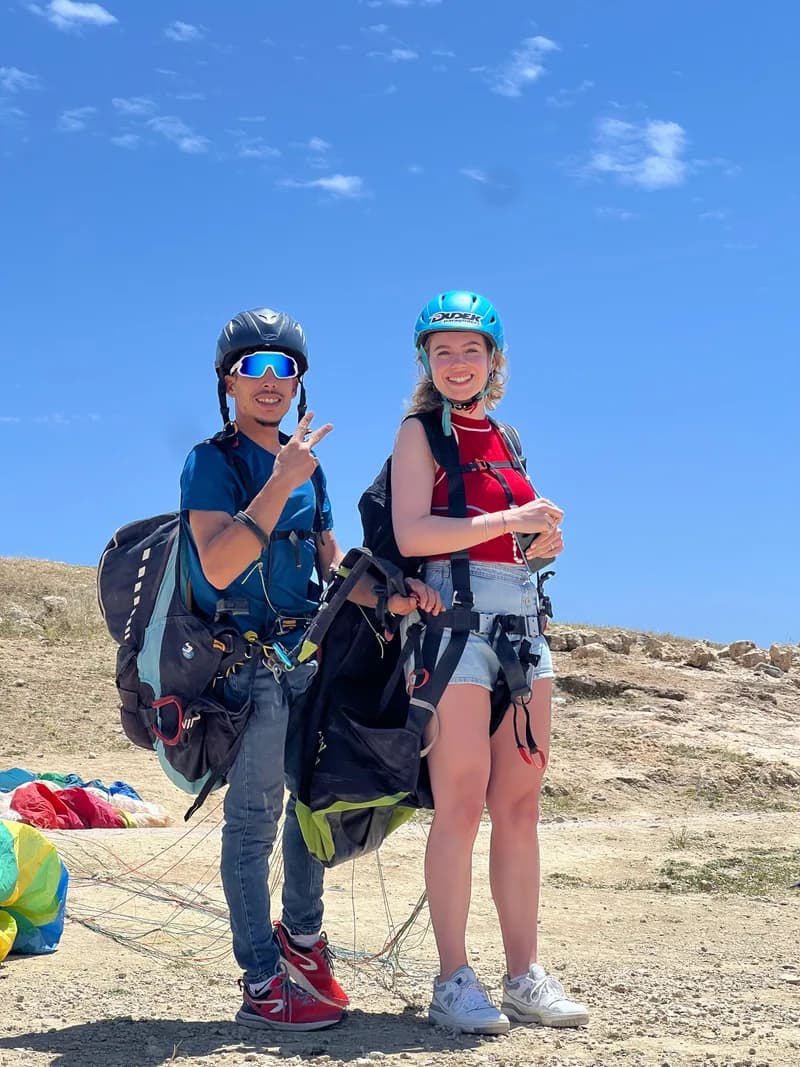
9. Does the pilot wear a helmet and proper footwear?
This sounds painfully obvious, which is exactly why it needs to be mentioned.
Some solo pilots may accept risks for themselves, including flying without proper shoes or a helmet.
Carrying a passenger is different.
During takeoff, the pilot and passenger may need to run over uneven ground. During landing, they may need to absorb movement or adjust quickly.
Proper footwear helps with:
Grip
Ankle support
Running
Balance
Landing stability
A helmet protects against impacts during preparation, takeoff, landing or an unexpected incident.
A tandem pilot refusing basic protective equipment demonstrates more than a clothing preference. It may reflect a wider attitude toward risk.
10. How does the pilot brief passengers before takeoff?
A professional pilot should explain the takeoff clearly.
The passenger usually needs to understand:
Where to stand
When to begin moving
That they must continue running
That they should not sit too early
What to do with their hands
What happens if the launch is stopped
How landing will work
How to communicate discomfort in the air
Takeoff is one of the moments when tandem experience becomes especially important.
The passenger does not know how the wing is inflating behind them. They may stop, jump, sit down or move sideways at the wrong moment.
The pilot must manage:
The wing
The direction
The passenger
Uneven ground
Wind changes
The decision to continue or abort
If the wing does not inflate correctly, an experienced pilot may stop the attempt and reset.
That is normal.
A failed first inflation does not mean the pilot is incompetent. Continuing with a poor wing position merely to avoid embarrassment would be much worse.
11. How does the operator assess the weather?
Weather applications are helpful, but they are not the final authority.
Pilots commonly use tools such as:
Windy
Windguru
General aviation forecasts
Local weather models
Wind and gust forecasts
These applications may indicate:
Wind direction
Average speed
Gusts
Cloud cover
Temperature
Rain
Expected changes during the day
But a forecast cannot perfectly describe one mountain launch.
Experienced pilots combine applications with direct observation.
At Aguergour, they may watch:
Windsocks
Clouds
Dust
Vegetation
Other paragliders
Birds
The movement of wings already airborne
Conditions at the lower landing field
The surface of the nearby lake
When the lake remains calm and reflective, it can indicate lighter or more stable airflow over that area.
When the reflection breaks and the water begins showing visible texture, pilots may recognise that stronger wind is moving across the lake toward the mountain.
This kind of local observation can reveal an approaching change before it reaches the launch.
12. Does the pilot communicate with other pilots?
Pilots at an active site rarely operate in complete isolation.
They watch one another and exchange information about:
Thermals
Stronger wind
Sinking air
Gusts
Turbulence
Landing conditions
Changes in direction
Whether new takeoffs should continue
A pilot in the air may recognise a problem before the people waiting at launch experience it.
Similarly, several wings suddenly climbing in one area can reveal a thermal.
Several experienced pilots landing or struggling to move away from the ridge can indicate that conditions are changing.
A professional local team benefits from this shared awareness.
Travelers should view communication between pilots as a positive sign rather than expecting one pilot to behave like a heroic solitary eagle with Wi-Fi.
13. Will the pilot cancel in unsuitable wind?
One of the most important signs of professionalism is the willingness to say no.
Around Aguergour, north and northwest winds are generally more favourable for the commonly used launch.
A southern wind can approach from behind the mountain or create disturbed airflow. Depending on the site and conditions, this can make the launch unsuitable or dangerous.
A responsible pilot may:
Delay the flight
Wait for another cycle
Reassess the conditions
Reorder passengers
Move the booking to another time
Reschedule the activity
Cancel completely
Customers should be cautious of guarantees such as:
“The flight always happens.”
“Weather does not matter.”
“We never cancel.”
“You will fly for exactly 20 minutes.”
“Everyone lands back at the top.”
“You will definitely reach a certain altitude.”
Paragliding is weather-dependent.
An operator willing to cancel may be more trustworthy than one who treats every unsuitable condition as an obstacle to revenue.
14. What happens when another pilot is assigned?
During busy periods, one team may receive more customers than its regular pilots can fly within the available weather window.
Using additional pilots is common and not inherently suspicious.
The important questions are:
Does the team know the additional pilot?
Is that pilot experienced in tandem flying?
Does the pilot understand Aguergour?
Does the pilot use suitable equipment?
Does the pilot follow the same weather decisions and passenger standards?
Who remains accountable for the customer’s booking and communication?
Sabarat uses a dedicated group of established pilots and may rely on additional professional pilots during periods of high demand.
The goal is not to promise that the same face appears in every booking photo. The goal is to ensure that every assigned pilot meets an acceptable professional standard.
Travelers may still ask for the pilot’s name before the activity.
15. What is the operator promising?
The language used in an offer can reveal a great deal.
Responsible wording usually sounds like:
Estimated flight duration
Depending on conditions
Subject to weather
Possible rescheduling
Passenger weight required
Final decision made by the pilot
Pickup time may adjust
Flight route and landing depend on the air
Irresponsible wording often sounds absolute:
Guaranteed exact duration
Guaranteed altitude
Guaranteed top landing
Guaranteed perfect weather
Zero risk
No cancellations
Same flight for every passenger
A professional operator explains uncertainty clearly because uncertainty is part of paragliding.
Someone hiding every variable until the customer reaches the mountain is not simplifying the experience. They are simply delaying the surprise.
Does a cheaper price mean the flight is unsafe?
Not necessarily.
Prices can differ because of:
Transport arrangements
Number of passengers
Included photographs and video
Refreshments
Marketing costs
Direct versus platform booking
Group discounts
Pilot availability
Vehicle recovery
Customer support
Equipment and operational costs
A lower-priced provider may still conduct flights professionally.
But unusually low prices should encourage travelers to ask what is included and what may have been removed.
Possible differences include:
No Marrakech pickup
No return transport
No media
No customer support
Older equipment
Larger groups with fewer pilots
No clear weather policy
No bottom-landing recovery
No meaningful cancellation support
Price alone cannot prove safety. It should be compared with pilot experience, equipment, communication and operating behaviour.
Should you ask to see insurance?
Yes, when insurance is claimed.
A professional operator should be able to explain:
The insurer
Who or what is insured
Whether the policy is current
Whether commercial tandem paragliding is covered
Whether passengers are included
Which exclusions apply
Some Moroccan operators may hold insurance through companies such as AXA, but travelers should verify the actual document rather than assuming that mentioning an insurer proves full coverage.
The precise coverage can differ between policies.
Until the policy is reviewed, avoid assumptions about:
Medical costs
Personal accident coverage
Third-party liability
Equipment damage
Rescue
International visitors
Commercial tandem operations
The document matters more than the logo printed on it.
What does Sabarat do differently?
Sabarat is not the pilot conducting the flight.
It is a platform connecting travelers with selected local operators while supporting discovery, booking and communication.
The flight itself is performed by the assigned tandem pilot and operating team.
Sabarat’s approach begins with direct relationships rather than anonymous inventory. It works with established pilots from the Marrakech paragliding community and may assign additional experienced pilots when demand requires it.
The intention is to make important information clearer, including:
Who the local team is
What the experience includes
Expected flight duration
Passenger restrictions
Weather dependence
Pickup and communication
What happens when conditions change
Sabarat should not claim that no risk exists or that every flight will be identical.
Its role is to make the booking process more transparent and connect customers with professionals selected through local knowledge to the greatest extent realistically possible.
Five questions to ask before booking
Travelers who do not want to conduct a complete aviation investigation over WhatsApp can begin with five questions:
1. Who will be my pilot?
Ask for the pilot’s name and whether they regularly conduct tandem flights at Aguergour.
2. What tandem experience and qualifications do they have?
Ask about years of tandem flying, federation documentation, local site experience and relevant training.
3. What happens if the weather becomes unsuitable?
The answer should explain delays, rescheduling, cancellation and communication.
4. What is included in the price?
Confirm transport, flight, equipment, media, refreshments and recovery after a lower landing.
5. What passenger weight limit applies?
A responsible team should ask for accurate weight before confirming the equipment and pilot assignment.
Warning signs before booking
Be cautious when an operator:
Refuses to identify the pilot
Never asks for passenger weight
Guarantees exact flight duration
Guarantees the flight regardless of weather
Cannot explain what happens after cancellation
Gives vague answers about equipment
Claims insurance but refuses to show evidence
Changes the price after arrival
Cannot explain the actual launch location
Pressures the customer to pay immediately
Provides no clear point of contact
Avoids questions about pilot experience
One warning sign does not always prove misconduct. Several warning signs together should not be ignored simply because the promotional video has cinematic music.
Warning signs at the launch
Passengers should take concerns seriously if they observe:
No helmets
Improper footwear
Poorly adjusted harnesses
Chaotic line preparation
No passenger briefing
Equipment that appears visibly damaged
Pressure to launch despite confusion
Pilots continuing while experienced teams stop
Strong backwind or visibly gusty conditions
Arguments or uncertainty about who will fly
Passenger weight being ignored
No clear plan for landing or recovery
A passenger has the right to refuse the flight if something feels seriously wrong.
Paying for an experience does not create an obligation to ignore obvious risk.
What professional behaviour looks like
A responsible team usually appears calm rather than dramatic.
Travelers may see:
Equipment prepared methodically
Passenger weight confirmed
Harnesses adjusted carefully
Clear takeoff instructions
Pilots watching the windsock and other wings
Communication between team members
Willingness to wait
Willingness to stop a takeoff
Honest explanations for delays
Respectful treatment of nervous passengers
A clear lower-landing and vehicle plan
Professional flying often looks less exciting on the ground because good preparation is repetitive, patient and uneventful.
That is exactly the point.
Final verdict
Choosing a paragliding operator in Morocco should not be based on price, follower count or one spectacular video.
The most important signals are:
Tandem experience
Local Aguergour knowledge
Responsible weather decisions
Suitable equipment
Weight and passenger assessment
Clear briefing
Recognised training or documentation
Honest promises
Communication
Willingness to cancel
A skilled solo pilot is not automatically a responsible tandem pilot.
A champion title is meaningful, but it should be considered alongside passenger care and judgement.
A certificate is useful, but it does not replace observation and accountability.
And a professional operator is not the person who promises that everything will happen exactly as advertised.
It is the person willing to explain what depends on the air, prepare for what may go wrong and refuse to fly when the conditions no longer justify it.
Esperienze Correlate
Prenota queste esperienze locali per vivere tu stesso le storie.