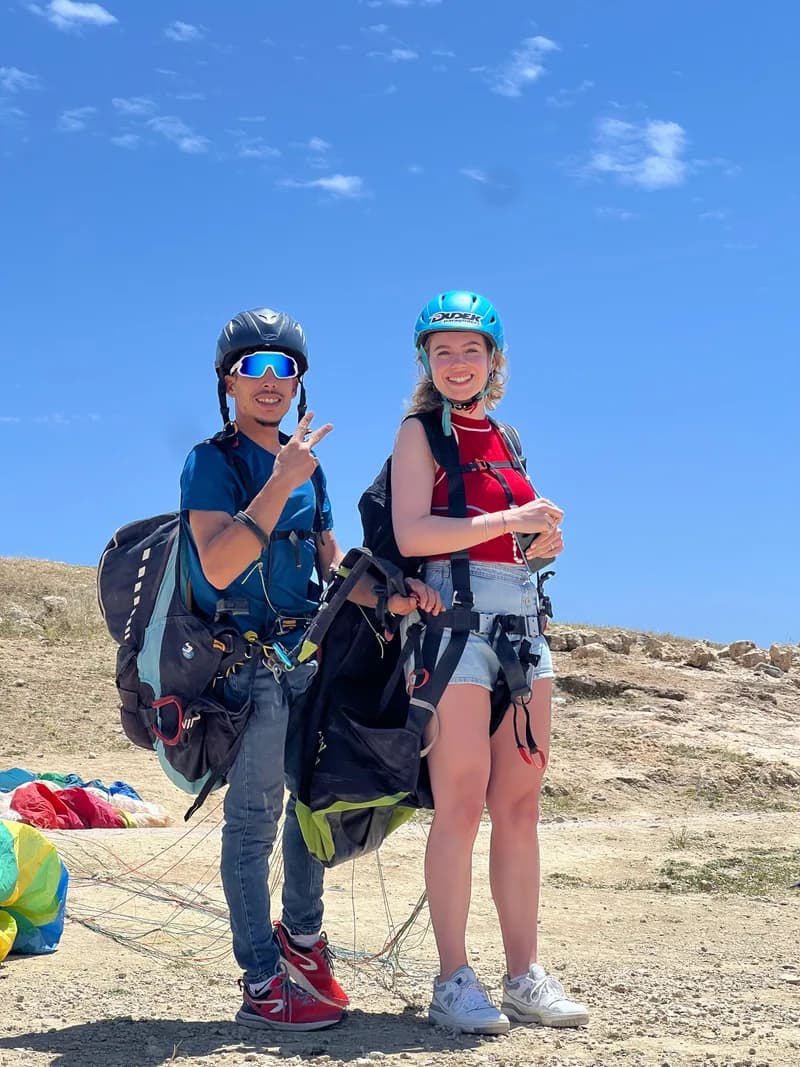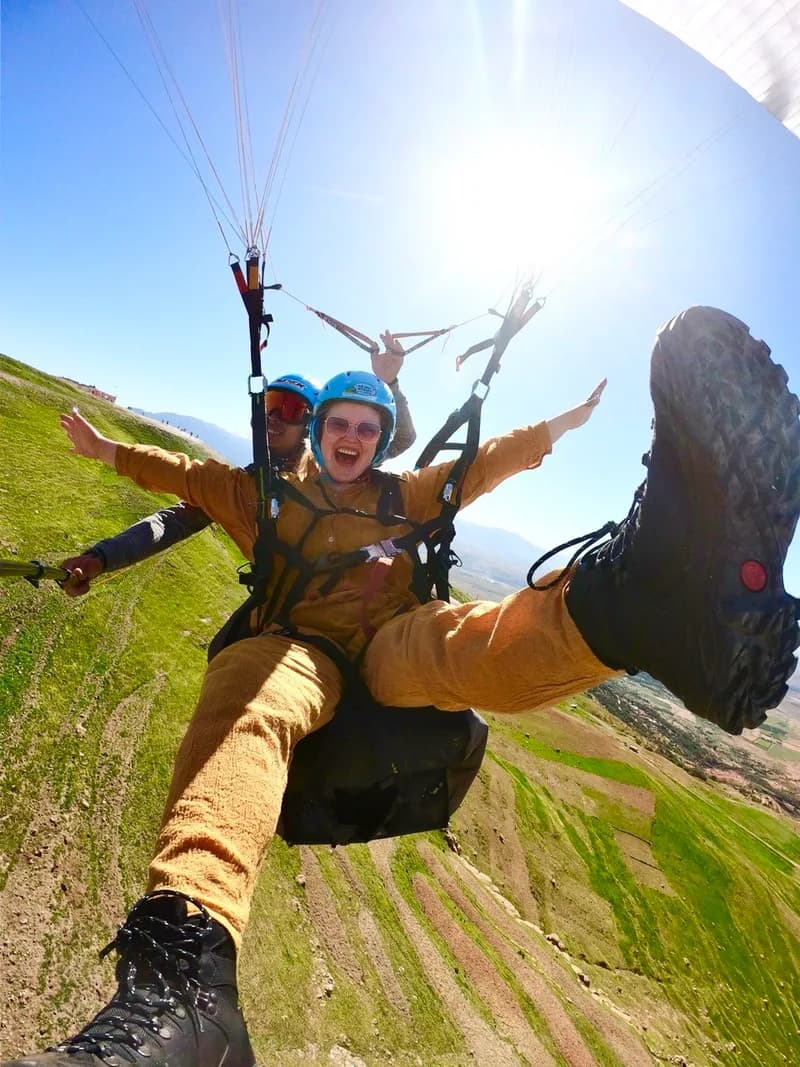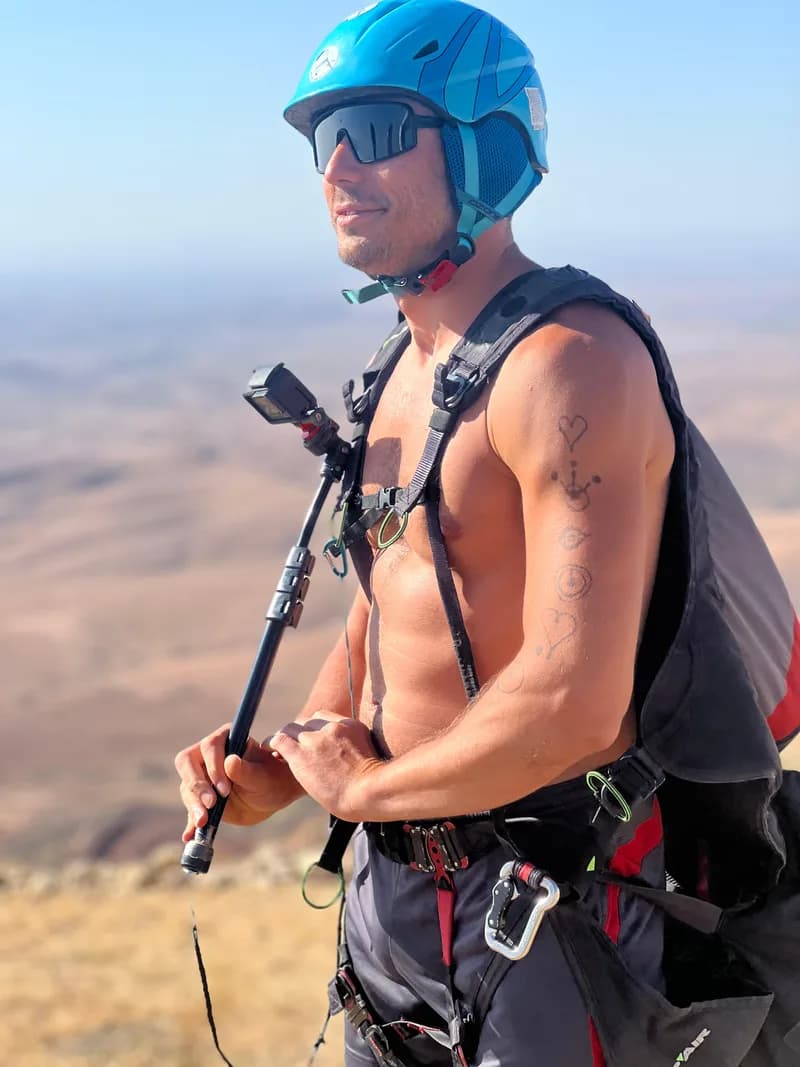
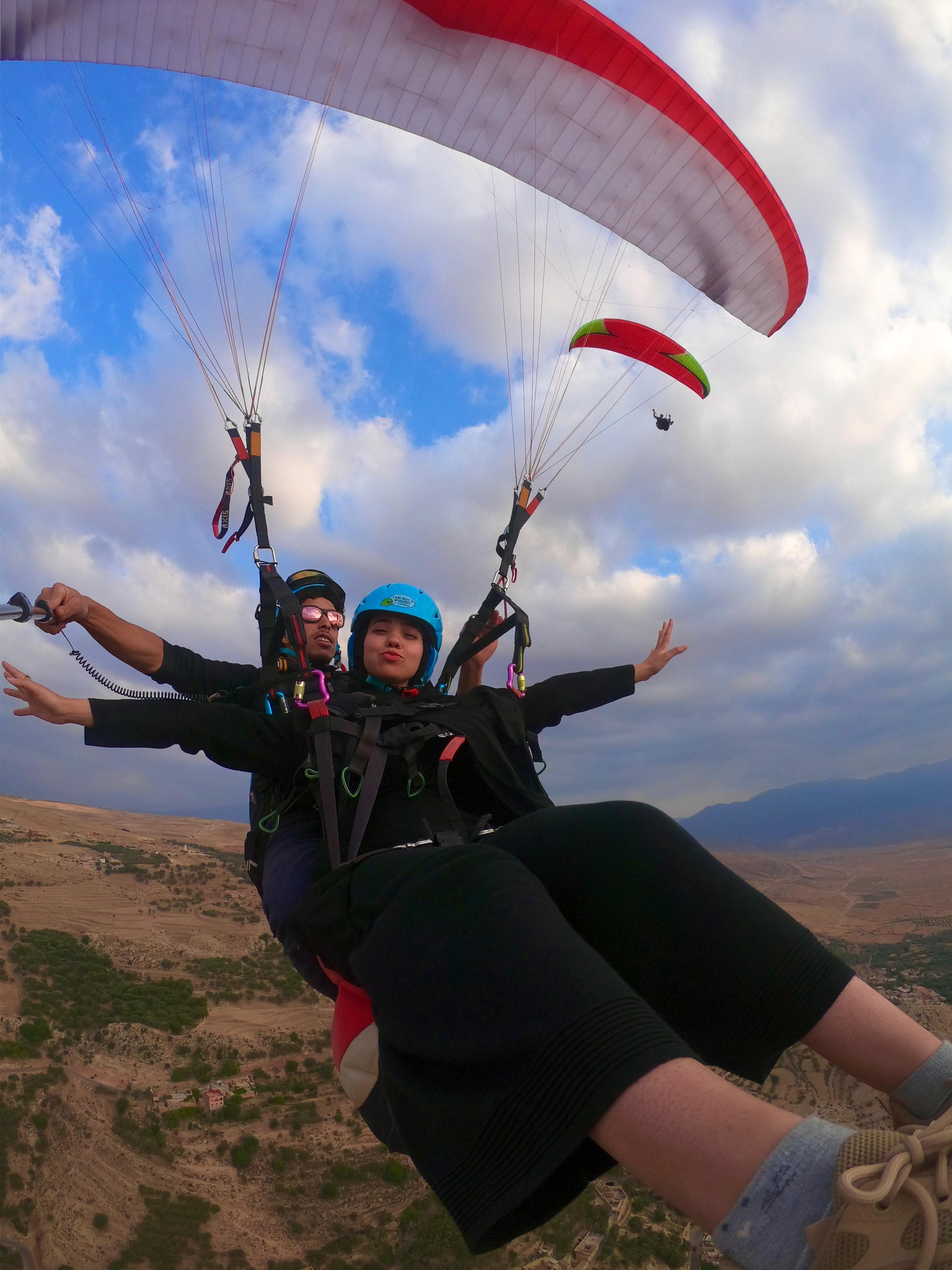
A tandem paragliding flight near Marrakech is often described as lasting around 15 to 20 minutes. That is a useful estimate, but it is not a guaranteed appointment with the atmosphere.
One passenger may remain in the air for longer, climb above the launch and enjoy a wide view across the Atlas foothills. Another passenger flying from the same mountain on the same day may gradually descend toward the lower landing field.
Sometimes those flights can take place less than twenty minutes apart.
The difference is not necessarily caused by poor planning or a pilot deliberately shortening the experience. Paragliding flight duration depends on a constantly changing combination of rising air, wind direction, thermal activity, passenger weight, wing loading and the pilot’s ability to understand the local conditions.
This is why paragliding is not like a cable car or an amusement ride. The pilot controls the wing, route and decisions, but nobody controls the air.
How long does a tandem paragliding flight last near Marrakech?
Around Aguergour and the Atlas foothills near Marrakech, a tandem flight will commonly be presented with an estimated duration rather than an exact one.
A typical expectation may be:
Around 15 to 20 minutes in ordinary conditions
Shorter when there is little usable lift
Longer when the pilot finds consistent rising air
Potentially much longer during exceptional soaring conditions
The total activity takes longer than the flight itself. Transport from Marrakech, preparation, safety instructions, waiting for suitable wind, equipment checks and the return journey must also be considered.
For groups, the activity can take additional time because passengers usually fly one after another. If pilots land below the mountain, they may also need to return to the launch by vehicle before flying with the next passengers.
Why does a paraglider naturally descend?
A paraglider does not remain at the same altitude automatically.
Even in completely still air, the wing moves forward while gradually descending. This is part of its normal glide performance. To remain level or gain altitude, the pilot must find air that is rising faster than the glider is sinking.
That rising air may come from:
Thermals created by the sun heating the ground
Wind being pushed upward by the mountain slope
A combination of terrain, temperature and regional airflow
Without enough rising air, the paraglider will continue moving forward and downward until it reaches the landing area.
Pilots often call a straightforward descending flight a sled ride. It can still be smooth, scenic and enjoyable, but it will usually be shorter than a soaring flight.
Season strongly affects the likelihood of a longer flight
Flight duration around Marrakech is closely connected to the season.
During winter and early spring, particularly from February to April, the area often receives more consistent north or northwest wind. The air can remain usable across a larger part of the day, giving pilots more opportunities to soar and return close to the launch.
Summer is much less predictable.
Strong sunshine heats the dry ground around Marrakech and the Atlas foothills. This can create powerful rising air, but it can also produce turbulent thermal cycles, sinking air between thermals and periods with almost no useful wind.
As an informal local rule of thumb, some experienced pilots describe descending-only flights as far more common during difficult summer periods than during favourable winter or spring conditions. They may describe the difference as something like:
Summer: as many as eight descending flights out of ten during poor cycles
Winter and spring: perhaps only one or two descending flights out of ten during favourable periods
These figures are not scientific probabilities or guarantees. They are a way local pilots express the major seasonal difference they observe in practice.
Summer can still produce exceptional high-altitude flights, particularly when a pilot enters a strong, usable thermal. But it can also produce short flights, turbulence, long waits and rapidly changing conditions.
How thermals extend a paragliding flight
A thermal is a column or bubble of warmer air rising from the ground.
The sun does not heat the landscape evenly. Rock, dry earth, roads, buildings, vegetation and shaded areas all warm at different rates. Air above the hottest areas begins to rise, creating invisible lift.
When a paraglider enters a thermal, the pilot can turn inside it and gain altitude. Instead of simply descending toward the landing field, the wing may climb hundreds of metres above the launch.
For the passenger, this can result in:
A longer flight
A higher viewpoint
Wider views over the landscape
More time to enjoy the experience
A better chance of returning toward the top of the mountain
Thermals also help the operation on the ground. When pilots remain high enough to return and land near the launch, they can prepare for the next passenger more quickly. When they descend to the bottom, a vehicle return may be necessary.
Thermals are invisible, so how do pilots find them?
Thermals cannot normally be seen directly. Experienced pilots learn to identify where rising air is likely to form and how the wing responds when they enter it.
They may look at:
Areas of the ground receiving strong sunlight
Darker rock or dry surfaces that heat quickly
Cloud development
Birds circling in rising air
Other paragliders gaining altitude
Changes in the wing’s pressure and movement
Variations in vertical speed
Patterns repeatedly observed at the same site
This is where local knowledge matters enormously.
An experienced pilot who has flown the same mountain for many years develops an understanding of where thermals commonly form, how they move and which signs suggest that a useful cycle is developing.
That does not mean an experienced pilot can create lift where none exists. But experience can greatly improve the ability to find, enter and remain inside rising air.
Ridge lift can keep pilots above the mountain
Thermals are not the only way to extend a flight.
When wind approaches a mountain slope from a suitable direction, the terrain pushes the air upward. This is known as ridge lift.
If the wind direction and speed are appropriate, a pilot can fly along the ridge and remain airborne without relying entirely on individual thermal bubbles.
Around Aguergour, north and northwest winds are generally more favourable for the commonly used launch orientation. When the flow is consistent, pilots may soar along the mountain and maintain altitude more easily.
Ridge lift can provide:
More predictable soaring
Easier movement along the mountain
Longer flight windows
Better opportunities to top-land
More efficient rotation between passengers
If the direction changes or the wind becomes weak, that support may disappear quickly.
Why one passenger climbs while another descends
Passengers sometimes compare their flights and assume that the longer one was “better” or that the shorter one was handled incorrectly.
The atmosphere does not distribute lift equally.
Imagine two passengers flying twenty minutes apart.
The first pilot launches just as a thermal releases from the ground. The wing enters rising air, climbs above the launch and remains airborne for an extended flight.
By the time the second passenger launches, that thermal may have moved away or weakened. The pilot searches for another area of lift but finds sinking or neutral air instead. The second flight gradually descends toward the lower landing field.
Both pilots may have made sensible decisions. They simply encountered different air.
Differences can also come from:
Pilot experience
The exact launch moment
Passenger and equipment weight
Wing size and loading
Wind strength
Thermal position
Other traffic in the air
Changing conditions near the landing area
This is why two flights from the same group are rarely identical.
Pilot experience can influence flight quality
Experience cannot control the weather, but it can strongly influence how effectively a pilot uses the conditions available.
A deeply experienced local pilot may be better able to:
Recognise when a thermal cycle is beginning
Predict where lift is likely to form
Centre the glider inside rising air
Avoid areas of sinking or turbulent air
Read changes in wind direction
Choose the right moment to launch
Decide when to stop searching and head for the landing field
Communicate with other pilots in the air
Adjust the flight to the passenger’s comfort
This distinction becomes especially important on difficult days.
A less experienced pilot may leave a weak thermal too early, fail to centre it properly or launch during an unhelpful part of the cycle. A highly experienced pilot may extract a better flight from the same general conditions.
Sabarat works with some of the earliest established pilots in the Marrakech region, including Moroccan champions with more than 16 years of flying experience. That does not allow anyone to guarantee a specific duration, but it provides the local knowledge and judgement needed to make the most of the conditions safely available.
Why weather apps cannot predict the exact flight
Pilots use forecasting tools such as Windy, Windguru and other aviation or weather applications to prepare for the following day.
These tools can provide useful information about:
Expected wind direction
Average wind speed
Gusts
Temperature
Cloud cover
Rain
Changes during the day
But a weather app cannot perfectly represent what will happen at one specific launch on one specific mountain.
Forecast models work across areas larger than the flying site. They may not fully capture:
Small terrain effects
Local heating
Wind flowing around the ridge
Short thermal cycles
Conditions near the lower landing field
Rapid changes caused by competing air masses
A forecast may indicate favourable north or northwest wind with limited gusts, only for pilots to arrive and find different conditions.
This does not happen every day, but it happens often enough that experienced pilots never rely on an app alone.
Forecasts help them prepare. The final decision comes from direct observation at the site.
How conditions can change within twenty minutes
The atmosphere above a mountain is not one uniform body of air.
Different layers and air masses can have different temperatures, speeds and directions. Local pilots sometimes describe these layers as competing with one another until one becomes dominant.
While the balance remains relatively stable, the conditions may feel manageable and predictable. When a hotter or faster-moving layer begins to dominate, the air can become stronger, more turbulent or less suitable for tandem flying.
A flight window may therefore change quickly:
The wind initially arrives from a suitable direction.
The first pilots launch in usable conditions.
Thermal activity increases.
Gusts become stronger or the direction begins shifting.
Pilots warn one another.
New launches are delayed or stopped.
Responsible pilots continually reassess the situation rather than assuming that conditions remain safe simply because someone launched earlier.
How pilots use the lake near Aguergour as a visual clue
The landscape itself can reveal approaching changes.
Experienced pilots around Aguergour keep an eye on the surface of the nearby lake. The water can act as a large visual indicator of airflow.
When the surface appears calm and reflective, it may suggest lighter or more stable wind over that part of the area.
When the reflection begins to break and the surface develops visible texture or ripples, it can indicate that the wind is strengthening or moving across the lake.
This does not replace proper weather assessment, windsocks or pilot judgement. It is one of several local clues.
Because the lake is visible before the changing air reaches parts of the mountain, pilots may sometimes recognise an approaching shift before it affects the launch.
This kind of site-specific observation is difficult to learn from an application. It comes from repeatedly flying the same terrain and understanding how the wider landscape behaves.
Pilots communicate with one another in the air
Paragliding may appear individual from the ground, but pilots constantly learn from one another.
During active flying, they may exchange information about:
Strong thermal areas
Sudden sinking air
Increasing wind
Turbulence
Changes in direction
Conditions at the landing field
Whether new takeoffs should be delayed
They also observe the behaviour of other wings.
If several pilots begin climbing in the same area, others can identify a thermal. If pilots suddenly struggle to move away from the ridge or begin landing, that may indicate that conditions are changing.
This shared awareness helps the entire group respond earlier.
How passenger weight affects flight duration
Every tandem wing has a certified weight range.
The relevant figure is not only the passenger’s weight. It is the total takeoff weight, including:
The passenger
The pilot
The wing
Both harnesses
The reserve parachute
Helmets and other equipment
The pilot must choose equipment suitable for the combined load.
Flying too lightly or too heavily can change the wing’s behaviour. Professional pilots should remain within the manufacturer’s approved weight range.
Within that range, heavier loading generally produces:
Higher airspeed
A higher descent rate
More dynamic handling
Greater momentum
Faster takeoff and landing speeds
Lighter loading generally produces:
Lower airspeed
A lower descent rate
Softer handling
Different behaviour in turbulence or stronger wind
A heavier passenger does not automatically make a good flight impossible. But in weak lift, the increased sink rate may make it harder to remain airborne for as long.
In stronger wind, additional loading can sometimes help the glider move forward more effectively. However, it can also increase the speed and energy involved during takeoff and landing.
Weight therefore has both advantages and disadvantages depending on the conditions. It must always be considered together with the wing, pilot, wind and terrain.
Can a professional pilot always provide a long flight?
No.
A highly experienced pilot can improve the chances of finding lift and using it efficiently. The pilot can also select a better launch moment and avoid wasting altitude unnecessarily.
But no pilot can manufacture rising air.
When the atmosphere provides only sinking or neutral air, the correct decision is often to accept a shorter flight and approach the landing field safely.
Trying to force a long flight can lead a pilot toward unsuitable terrain, turbulence or an uncomfortable experience for the passenger.
Professionalism is not proven by keeping every passenger airborne for the maximum possible time. It is proven by knowing when to continue, when to land and when not to launch at all.
Why a shorter flight is not necessarily a bad flight
Flight duration is only one part of a tandem paragliding experience.
A shorter flight may still include:
A smooth takeoff
Beautiful views
Calm gliding
Gentle turns
Clear communication
A comfortable landing
Photos and video
Relief from Marrakech’s summer heat
A long flight in turbulent air may be less enjoyable than a shorter, smoother one.
Passenger comfort also matters. Some people enjoy circling in thermals, while others begin feeling motion sickness. A pilot may decide to land earlier if the passenger becomes uncomfortable, even when lift remains available.
The best flight is not always the longest one. It is the flight that makes responsible use of the day’s conditions while respecting the passenger’s safety and comfort.
How flight duration affects groups
Groups should plan for variation.
Imagine a group of six passengers flying with several tandem pilots.
If the pilots find good lift and can land near the top, the group may rotate efficiently. Wings can be prepared again, and each pilot remains close to the launch.
If the flights descend to the lower landing area, the pilots and equipment must return by vehicle. This can add significant waiting time before the next passengers fly.
A group booking may therefore take longer because of:
Weather cycles
Different flight durations
Bottom landings
Vehicle recovery
Passenger preparation
Equipment changes
Pilot rest and safety checks
Delayed launches while conditions are reassessed
The total activity duration should never be calculated by simply multiplying the advertised flight time by the number of passengers. The mountain, wind and logistics stubbornly refuse to operate like a spreadsheet.
Can paragliding flight time be guaranteed?
No responsible paragliding operator should guarantee an exact flight duration.
A realistic operator can provide an expected range based on:
The flying site
The season
Typical conditions
The planned flight type
Previous local experience
But the actual duration remains dependent on the air encountered after takeoff.
Travelers should be cautious when an operator guarantees:
An exact number of minutes
A specific altitude
A top landing
A high-altitude flight
A flight regardless of weather
Identical flights for every member of a group
Those promises ignore the nature of paragliding.
What should passengers expect when booking?
A well-presented tandem experience should explain:
The estimated flight duration
That actual airtime depends on conditions
The total expected activity duration
The possibility of waiting
The possibility of a lower landing
How large groups are organised
Weight restrictions
What happens if the wind changes
Rescheduling and cancellation arrangements
Passengers should also remain flexible, particularly during summer.
Avoid placing the experience immediately before an airport transfer, train departure or another fixed commitment. A delayed launch may produce a better and safer flight than forcing the original schedule.
Final answer: how long does paragliding last in Marrakech?
A tandem paragliding flight near Marrakech commonly lasts around 15 to 20 minutes, but it may be shorter or longer.
The most important factors are:
Rising air
Thermal strength
Ridge lift
Season
Wind direction
Changes during the day
Passenger and equipment weight
Wing loading
Pilot experience
Passenger comfort
Winter and spring generally provide a better chance of sustained soaring. Summer can produce extraordinary high flights, but it also brings a much greater possibility of sinking air, turbulence and short flying windows.
The pilot can read the sky, choose the launch moment and search for lift.
The pilot cannot command the atmosphere.
That uncertainty is not a flaw in paragliding. It is part of what makes every flight genuinely different.