If you are planning to go paragliding in Morocco, July or August may seem like the obvious choice. They are among the most popular months for visiting Marrakech, the skies are usually clear, and the days are long.
But popular does not necessarily mean ideal.
Around Marrakech and the Atlas Mountains, the most consistently rewarding period for paragliding is usually from February through April. Spring often brings more manageable wind, longer flying windows, easier takeoffs, beautiful cloud formations, and better conditions for both tandem passengers and experienced solo pilots.
Summer can still produce extraordinary flights, especially near sunset. It can also bring stronger thermals, sudden changes in wind direction, turbulent air, long periods without useful lift, and a much greater need for experienced local decision-making.
This guide explains why.
Important: Morocco has several paragliding regions, each with its own terrain and microclimate. This article focuses primarily on the Marrakech and Atlas foothill sites, including the flying conditions commonly experienced around Aguergour. No season guarantees a flight. The final decision must always depend on the conditions observed that day.
The best time to paraglide in Morocco
For the Marrakech and Atlas Mountains region, the best overall period is generally:
February to April
During these months, local flying sites often receive more consistent winds from the north or northwest. The air is usually active enough to support soaring, but not as aggressively heated as it can become during high summer.
This creates several advantages:
More usable flying hours during the day
Smoother and more predictable takeoffs
Better chances of finding sustained lift
Fewer extreme heat-related thermal cycles
Easier flight planning for groups
More opportunities for pilots to remain airborne
Cooler temperatures on the ground
Dramatic clouds and clearer mountain scenery
March and April can offer an especially attractive balance between comfortable temperatures, active air and visual conditions. February may be cooler and occasionally more changeable, but it can still provide excellent flying days.
The most important difference is not simply that spring has “more wind.” It is that the wind and thermal activity are often more usable for paragliding.
Why summer is not automatically the best paragliding season
Marrakech is extremely hot in July and August. Official climate information places July among the hottest periods of the year, with average daytime temperatures around the high 30s and significantly higher temperatures possible during heatwaves.
That heat changes the behaviour of the air.
The sun heats the ground, which then heats the air directly above it. As that warmer air rises, it forms columns or bubbles of rising air known as thermals. Pilots use thermals to gain altitude and remain airborne.
Thermals are not inherently bad. They are one of the main reasons paragliders can climb rather than simply descend from the launch.
The problem is that intense surface heating can make those thermals stronger, sharper and less organised. The air around the edges of a thermal may also be turbulent. Both the British Hang Gliding and Paragliding Association and the United States Hang Gliding and Paragliding Association identify thermal activity, turbulence, strong winds and sudden weather changes as conditions requiring skill and careful judgement.
This is why a clear, sunny summer day is not necessarily a simple flying day.
What summer thermals feel like
People sometimes describe summer conditions as “hot wind rising from the ground.” In meteorological terms, this is convective activity caused by strong surface heating.
The ground does not warm evenly. Rock, dry soil, roads, vegetation and shaded areas absorb and release heat differently. Rising air may therefore form in separate pockets rather than as one smooth, continuous current.
This can produce alternating periods of:
Strong rising air
Sinking air
Sudden changes in lift
Gusts near the launch
Turbulence around thermal boundaries
Long pauses with little useful wind
Rapid changes in the behaviour of the wing
For an experienced solo pilot, active summer air may offer an exciting technical challenge.
For a tandem passenger, however, the experience may be less predictable. One flight may climb high above the ridge, while another flight shortly afterwards may mainly descend toward the lower landing area.
That does not necessarily mean either flight was handled incorrectly. It means paragliding depends on a moving atmosphere, not a machine following a fixed track.
Why some summer flights only go down
A paraglider is always descending through the surrounding air. It gains altitude only when the air itself rises faster than the wing descends.
When a pilot finds usable thermal or ridge lift, the glider may climb, remain at a similar altitude, or soar above the launch.
When that lift disappears, the flight becomes what pilots sometimes call a sled ride: a controlled descent from the takeoff area to the lower landing field.
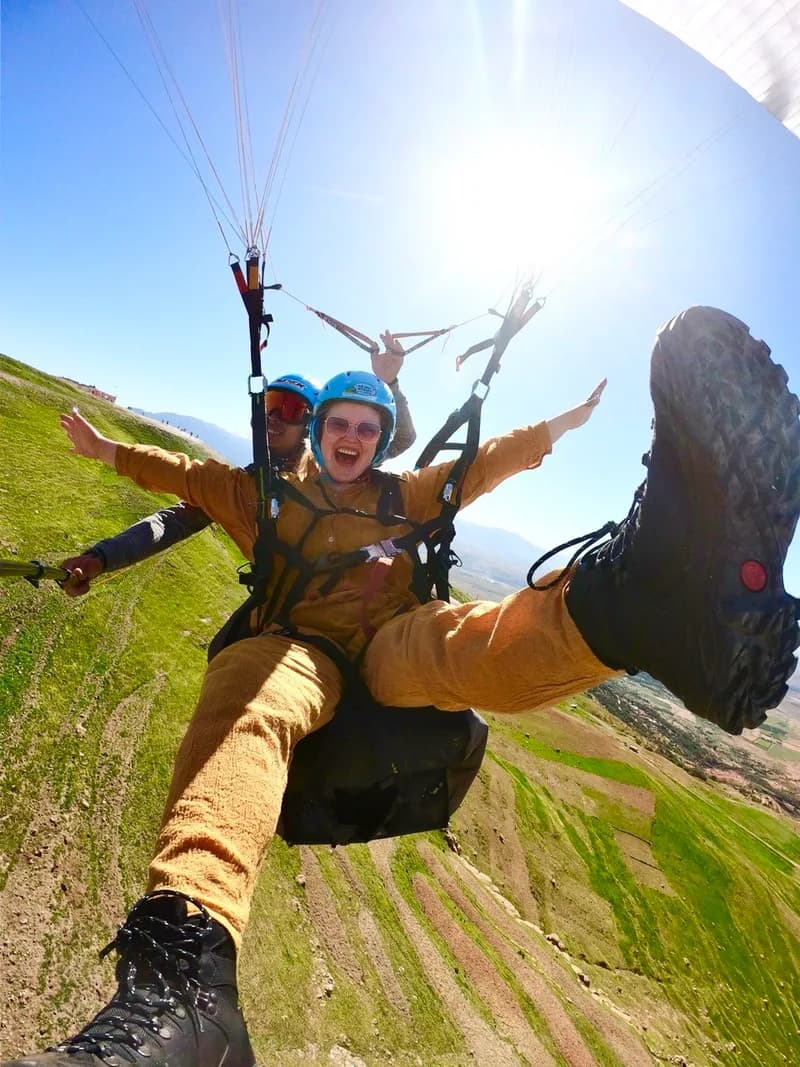
A descending flight can still be enjoyable. The passenger sees the landscape from the air and experiences the launch, glide and landing. But it may be shorter and less dramatic than a soaring flight in which the pilot climbs hundreds of metres above the ridge.
Summer can contain strong lift, but it can also contain pronounced lulls between thermal cycles. Booking during July or August therefore does not guarantee a high-altitude experience merely because the day is hot and sunny.
How the conditions affect group logistics
The wind also changes how efficiently tandem groups can fly.
When the air supports soaring and conditions allow a safe top landing, a pilot may be able to land close to the launch area. The next passenger can then prepare without waiting for the pilot to return from the bottom of the mountain.
When there is insufficient lift, the pilot and passenger may land in the lower landing field. The pilot then needs to travel back to the launch by vehicle before flying with another member of the group.
For a couple, this may cause only a modest delay. For a larger group, repeated lower landings can extend the total duration of the activity considerably.
This is one reason consistent spring conditions can improve more than the flight itself. They can also make the overall operation smoother.
Summer requires highly experienced pilots
Strong thermals, shifting wind and mountain terrain demand judgement.
A skilled tandem pilot must assess more than the basic wind speed. The decision may also depend on:
Wind direction
Gust strength
Thermal cycles
Cloud development
Conditions above the launch
Airflow around the ridge
Available landing options
Changes expected later in the day
The passenger’s weight and comfort
Other gliders already in the air
Paragliding weather can change quickly. A condition that is acceptable at one moment may become unsuitable later.
This is why a responsible operator may delay a flight, move it to another time, or cancel it completely. A cancellation is not evidence that the operator failed to provide the activity. In many cases, it is evidence that the pilot refused to gamble with unsuitable air.
Why a south wind can cancel the flight
Wind direction matters as much as wind strength.
The launch sites discussed here are generally suited to particular wind directions, commonly from the north or northwest. When the wind arrives from the expected direction, it flows toward and over the slope in a way that can support takeoff and soaring.
A southerly wind may approach from behind the launch or interact dangerously with the mountain.
Attempting to launch into unsuitable backwind conditions can expose the paraglider to disturbed airflow, rotor and an increased risk of being pushed toward the terrain.
At these sites, a confirmed southerly flow can make flying impossible. Responsible pilots cancel rather than attempting to force the activity to happen.
Travelers should therefore be cautious of anyone who promises that a tandem flight will take place regardless of wind direction. Weather is not an inconvenience that professionalism can overpower. Recognising when not to fly is part of professional flying.
The summer sunset window
Summer is not without advantages.
Late afternoon and sunset can sometimes provide some of the most memorable flying conditions of the year.
As direct surface heating weakens, the harshest convective activity may begin to settle. On certain days, residual lift, convergence or a well-timed thermal cycle can still carry the paraglider high above the mountain.
This can create:
Higher-altitude flights
Softer evening light
Long shadows across the Atlas foothills
Clear views toward Marrakech
Cooler-feeling air
A more comfortable passenger experience
The contrast can be remarkable. Marrakech may still feel intensely hot on the ground, while the airflow and altitude make the flight feel refreshing.
Sunset is not automatically smooth or flyable, however. Summer wind can remain strong, shift direction, or disappear completely. The late-afternoon window must still be evaluated on the day.
Why February to April usually offers better conditions
Spring around Marrakech often provides a more useful balance between surface heating and regional wind.
The ground still receives enough sunlight to generate lift, but the heating is usually less severe than during July and August. North and northwest winds are also commonly favourable for the local launch orientation.
This can result in air that is:
Active without being excessively aggressive
Consistent enough for soaring
Manageable during takeoff
More useful across a larger part of the day
Better suited to consecutive tandem flights
More comfortable for passengers waiting at launch
Spring does not eliminate turbulence, cancellations or changing weather. No real pilot would make that promise with a straight face. But the useful flying window is often broader than it is during high summer.
Instead of waiting for one brief opportunity near sunset, pilots may find acceptable conditions from earlier in the day through the afternoon.
Spring skies can be more beautiful
Clear blue skies are attractive, but they are not always the most visually interesting skies for paragliding.
During February, March and April, clouds are more likely to add depth and scale to the landscape. When conditions are suitable, cumulus clouds can also reveal where rising air is present, because moisture may condense as thermals rise and cool.
From the air, these conditions can create extraordinary scenes:
Sunlight breaking between clouds
Shadows moving over the hills
Snow or haze over the distant Atlas peaks
Layers of light above the plains
Multiple gliders circling below cloud-marked lift
Rich colour around sunrise or late afternoon
A completely empty blue sky can still be beautiful. But a textured spring sky often gives the flight the appearance of a moving painting.
The best season for solo paragliding in Morocco
February to April is not only attractive for tandem passengers.
It is also an important period for experienced solo pilots travelling to Morocco.
Pilots who understand the region’s seasonal pattern often plan their trips during spring because they are looking for more than a short descent. They want to thermal, soar, remain airborne and share the sky with other pilots.
On suitable days, the launch may bring together:
Moroccan pilots
Visiting European and international pilots
Tandem professionals
Paragliding schools or guided groups
Passengers taking their first flight
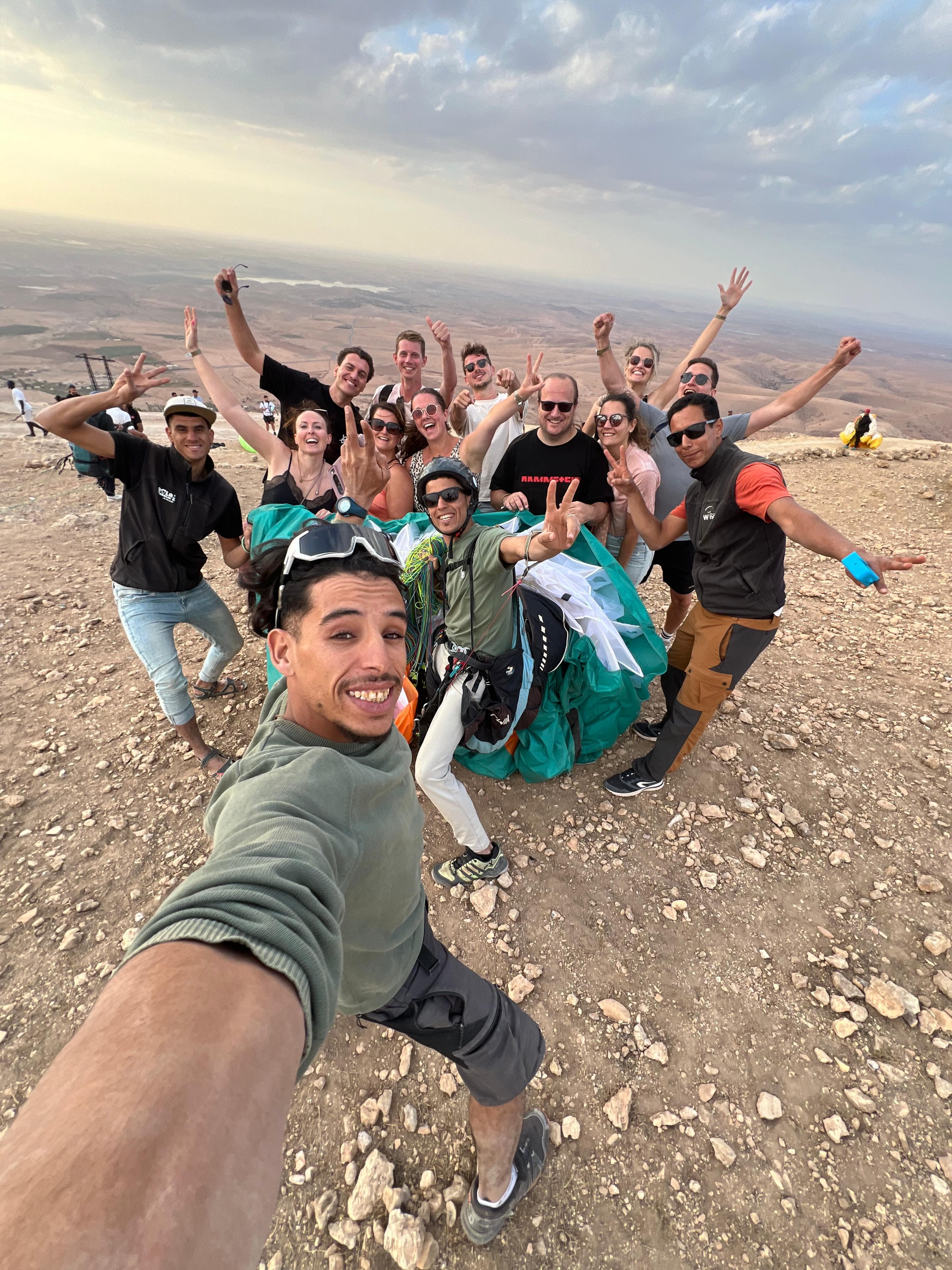
Once airborne, pilots may circle together inside the same broad area of lift, following standard right-of-way and thermalling rules. A good spring day can keep experienced pilots in the air for hours.
This creates a distinctive atmosphere. The site feels active without being purely touristic. Visitors see local and international pilots exchanging information, preparing wings, watching the clouds and waiting for the right cycle.
Ironically, many ordinary tourists know very little about this season. Visitor numbers rise sharply during summer, while some of the most useful flying conditions arrive earlier in the year.
Does this mean you should avoid paragliding in summer?
No.
Summer paragliding near Marrakech can be spectacular. It can offer clear visibility, dramatic height gains, cooling air and unforgettable sunset scenery.
It is simply more variable than many travelers expect.
A summer booking works best when the traveler:
Chooses an experienced local tandem team
Remains flexible about timing
Accepts that the flight may be delayed
Understands that duration and altitude cannot be guaranteed
Allows the pilot to cancel if wind direction becomes unsuitable
Avoids planning the activity immediately before a flight home
Does not pressure the operator to fly in doubtful conditions
The mistake is not visiting in summer. The mistake is assuming sunshine and heat automatically create perfect flying weather.
What is the best time of day to paraglide?
The answer changes with the season and the individual day.
From February to April
Suitable conditions may develop earlier and remain available across a wider part of the day. Morning, midday and afternoon flights may all be possible when the wind direction and strength remain appropriate.
During July and August
Late afternoon and the period approaching sunset can sometimes be more comfortable and more rewarding. The strongest daytime heating may begin to weaken, while useful residual lift can remain.
But there is no universal departure time. The pilot should choose the window based on live conditions rather than a fixed timetable written days in advance.
Can paragliding be guaranteed?
No responsible operator can guarantee that a flight will happen.
Paragliding depends on wind direction, wind strength, gusts, thermal activity, visibility, clouds and local terrain effects. Sudden changes may create challenging conditions even after a day initially appears promising. Aviation safety organisations consistently emphasise that weather awareness and sound judgement are essential parts of free flight.
A trustworthy booking process should therefore explain what happens when conditions are unsuitable, including rescheduling, cancellation and communication.
The final verdict
For tandem passengers and solo pilots flying around Marrakech and the Atlas foothills, February through April is usually the best time to paraglide in Morocco.
Spring tends to offer:
More consistent north or northwest winds
Longer usable flying windows
Easier takeoffs
Better chances of sustained soaring
More efficient group operations
Comfortable ground temperatures
Beautiful cloud formations
A lively international flying community
July and August can still produce exceptional flights, particularly around sunset. But high temperatures, strong thermal cycles, turbulence, lulls and shifting wind direction make summer more technically demanding and less predictable.
The best paragliding day is not necessarily the hottest, sunniest or busiest day.
It is the day when the wind, terrain, thermal activity and pilot’s judgement come together in the right way.